Fire, Famine and a Fiery Chariot: Why Mendelssohn's Elijah Still Thrills Audiences

| Type of post: | Choir news item |
| Sub-type: | No sub-type |
| Posted By: | Tim O'Riordan |
| Status: | Current |
| Date Posted: | Mon, 6 Jul 2026 |
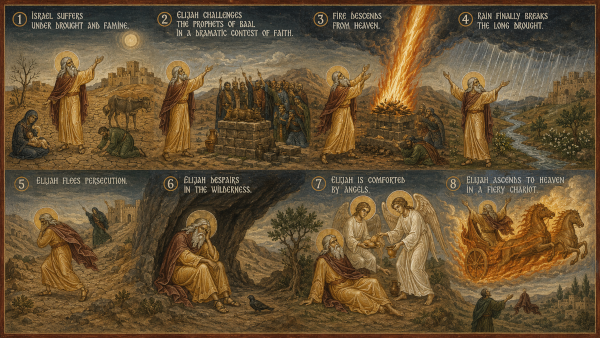
A prophet curses a nation into drought. Fire falls from a clear sky. A man flees into the wilderness, certain he is the last good soul left alive - and is answered not by thunder, but by a voice so quiet it can barely be heard. Then, at the very end, he is swept up to heaven in a chariot of flame.
It sounds like the plot of a blockbuster. It is, in fact, one of the great Victorian oratorios, and on Saturday 14th November, Southampton Choral Society brings Mendelssohn's Elijah to Chandler's Ford Methodist Church, joined for this performance by Cheriton Singers, the Conchord Singers and the Winchester Symphony Orchestra. Three choirs, one almighty sound.
A masterpiece a decade in the making
Mendelssohn first started circling the idea of Elijah in the 1830s, but it took him more than ten years — and a great deal of badgering of his librettist, Julius Schubring — to get the text right. He wanted no static Bible-reading-with-orchestra; he wanted characters who, in his own words, "act and speak as if they were living beings." The result finally reached the stage at the Birmingham Triennial Festival on 26 August 1846, with Mendelssohn himself on the podium — 180 years ago this year.It was, by any measure, a sensation. The audience interrupted the performance to demand encores for eight separate numbers — an extraordinary occurrence even by the standards of the day. The critics were just as swept away.
Never was there a more complete triumph - never a more thorough and speedy recognition of a great work of art ... altogether one of the most extraordinary achievements of human intelligence — The Times, 29 August 1846.
Handel and Bach, reimagined
Mendelssohn revered both composers, and you can hear it: the weight and grandeur of the choruses owe a clear debt to Handel, while the chorales and contrapuntal writing nod unmistakably to Bach. But Elijah never feels like an exercise in homage. It is Romantic through and through — urgent, theatrical, and emotionally direct in a way that neither of his models quite attempted.The story
Israel is gripped by famine. Elijah challenges the prophets of Baal to a very public contest of faith — and wins, dramatically, with fire from heaven. Rain finally breaks the drought. Then the story turns inward: Elijah, persecuted and despairing, flees to the wilderness, is comforted by angels, and at last hears God not in wind, earthquake or fire, but in a "still small voice" — one of the most quietly devastating moments in the entire choral repertoire.What to listen for
The chorus carries much of the drama, transforming across the evening from a frightened, suffering crowd into a body of fervent worshippers. Listen out for:"Thanks Be to God" — the choir's full-throated release as the drought finally breaks.
"Be Not Afraid" — tender, consoling, and a world away from the storm music either side of it.
The storm and fire sequences — where Mendelssohn's orchestration does as much storytelling as the words.
The hush around the "still small voice" — arguably the emotional heart of the whole work.
Three choirs, one performance
This concert brings together the combined forces of Southampton Choral Society, Cheriton Singers and Conchord Singers providing an unmissable opportunity to hear Elijah's massed choruses sung with real scale and weight, in a work that was, after all, written for exactly that kind of grandeur.Podcast 02 - Autumn 2026
Narration generated using elevenlabs.io text to speech synthesis processing.
Highlights from "Elijah" performed by The Royal Philharmonic Orchestra and The Royal Choral Society, conduscted by Sir Malcolm Sargeant. via The Internet Archive.

Where: Chandler's Ford Methodist Church, Eastleigh, SO53 2GE
When: 7.30pm, Saturday, 14 November 2026
Ticket price (including booking fee): £5.39 and £21.56
Tickets (Ticketsource):
Click here to book
Join our mailing list to keep up to date with our activities and events (Mailchimp)